
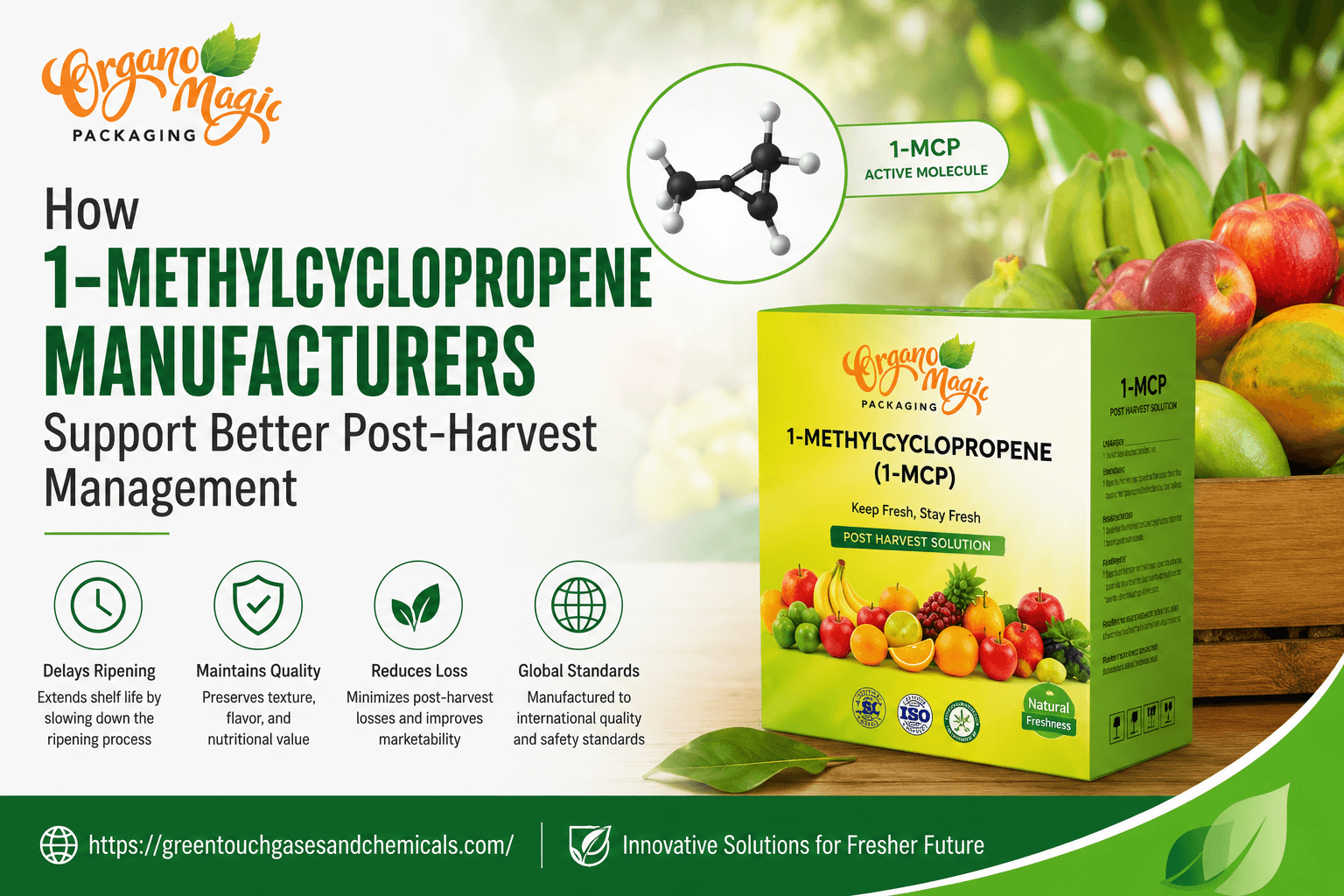
How 1-Methylcyclopropene Manufacturers Support Better Post-Harvest Management
Maintaining freshness after harvest is a major challenge for growers, packhouses, distributors, exporters, and retailers. Fruits and vegetables continue to undergo natural physiological changes after being harvested. Ethylene, a plant hormone associated with ripening and senescence, can accelerate these changes in susceptible produce.
This is where controlled post-harvest technologies can become valuable. A reliable 1-methylcyclopropene manufacturer can support the supply chain by providing products designed to influence ethylene-related ripening processes. However, choosing a suitable solution requires more than comparing prices. Product quality, application requirements, storage conditions, documentation, regulatory considerations, and technical support should all be evaluated.
Quick Answer
1-MCP is a post-harvest technology used to manage ethylene-related ripening in certain fruits and vegetables. Manufacturers support better post-harvest management by providing consistent formulations, technical guidance, quality documentation, and suitable packaging. When correctly integrated with harvesting, cold storage, transportation, and handling practices, it can help businesses manage produce quality more effectively.
What Is 1-Methylcyclopropene?
1-Methylcyclopropene, commonly known as 1-MCP, is a compound used in post-harvest management because of its interaction with ethylene receptors in plants. Ethylene naturally influences processes such as ripening, softening, colour development, and senescence.
By affecting ethylene perception, 1-MCP can help slow certain ripening-related changes in suitable commodities. However, its performance is not identical for every fruit or vegetable. Crop variety, maturity, temperature, treatment timing, concentration, exposure conditions, and storage environment can all influence results.
For this reason, 1-MCP should be considered as one part of an integrated post-harvest strategy rather than a standalone answer to every storage challenge.
Why Do Manufacturers Play an Important Role?
Manufacturing consistency is important when a product is used as part of a commercial post-harvest programme. Growers and produce handlers need reliable formulations and clear instructions to establish repeatable treatment processes.
A responsible manufacturer should maintain suitable quality-control procedures throughout production, packaging, and storage. Product traceability and batch information can also help businesses maintain better internal records.
Manufacturers can contribute further value by providing technical information about intended applications, handling requirements, storage conditions, and product limitations. This information helps users make decisions based on technical suitability rather than promotional claims.
How Can 1-MCP Support Better Post-Harvest Management?
The main role of this technology is to influence ethylene-related physiological activity. For suitable produce, managing this process can help businesses better coordinate storage and distribution schedules.
For example, harvested produce may move through several stages before reaching consumers. It may spend time at a packhouse, in cold storage, during transportation, at a distribution centre, and finally at a retail location. Managing ripening behaviour can be particularly relevant when these stages involve extended transit times.
However, treatment results depend on the complete handling environment. Good harvesting practices, temperature control, appropriate humidity, careful handling, and sanitation remain essential.
What Should You Look for in a 1-Methylcyclopropene Manufacturer?
When evaluating a manufacturer, businesses should look at both technical and commercial factors. Product documentation should clearly explain the formulation, intended application, handling requirements, storage conditions, and relevant precautions.
The manufacturer should also demonstrate a structured approach to quality management. This may include batch identification, testing procedures, consistent packaging, and traceability.
Three practical areas deserve particular attention:
Product consistency: Consistent specifications help commercial users establish repeatable treatment procedures.
Technical guidance: Clear instructions can help businesses understand appropriate application conditions.
Documentation: Product specifications, batch information, safety documentation, and regulatory information support responsible purchasing and record keeping.
How Does a 1-Methylcyclopropene Supplier Support the Supply Chain?
A 1-methylcyclopropene supplier can help connect manufacturers with businesses involved in produce handling, storage, distribution, and export. Supply reliability is important when a treatment is incorporated into a regular post-harvest workflow.
A supplier may support customers through product availability, packaging options, delivery coordination, documentation, and communication about application requirements.
For larger operations, consistency of supply can become a major consideration. A business should understand expected lead times, ordering requirements, storage conditions, and the availability of technical assistance before establishing a long-term programme.
What Regulatory Factors Should Businesses Consider?
Post-harvest products can be subject to different regulatory requirements depending on the country, crop, formulation, intended use, and product classification.
Businesses should verify applicable requirements with the relevant authorities before commercial application. They should also review product labels, technical documentation, safety information, batch records, and usage instructions.
Regulatory compliance should not be assumed simply because a product is available in the market. Exporters should also consider requirements in destination markets because acceptable treatments and documentation can differ between jurisdictions.
Manufacturers and suppliers should communicate limitations clearly and avoid unsupported claims about universal shelf-life extension or guaranteed quality improvement.
What Common Mistakes Should Businesses Avoid?
One of the most common mistakes is applying identical treatment assumptions to different commodities. Fruits and vegetables can respond differently to ethylene management, and even different varieties of the same commodity may behave differently.
Another mistake is overlooking the cold chain. Poor temperature management can significantly affect produce quality even when an appropriate post-harvest treatment is used.
Businesses should also avoid selecting a product solely because it has a lower purchase price. The actual value depends on product suitability, application efficiency, documentation, consistency, technical support, and overall operating requirements.
Best Practices for Effective Use
A structured approach can help businesses evaluate whether a post-harvest treatment fits their operation.
- Identify the crop, cultivar, maturity stage, and expected storage period.
- Review the manufacturer's technical guidance and applicable regulatory requirements.
- Conduct controlled trials before introducing a treatment across a large commercial operation.
- Monitor measurable quality factors such as firmness, colour, appearance, weight loss, and marketability where relevant.
- Maintain records of treatment conditions, storage temperatures, batch information, and observed results.
Testing should be designed around the actual conditions of the business rather than relying exclusively on laboratory or supplier examples.
How Does 1-MCP Fit Into the Cold Chain?
Post-harvest treatment works most effectively when integrated with good storage and transportation practices. Temperature management remains one of the most important factors influencing produce quality.
Handling procedures should minimize bruising and mechanical damage. Storage areas should maintain suitable environmental conditions, while transportation should preserve the required temperature and humidity as closely as possible.
This integrated approach allows businesses to address several causes of quality deterioration rather than relying on a single technology.
Expert Considerations Before Purchasing
Businesses considering this type of product should assess the entire operating process. The appropriate solution depends on the commodity, treatment facility, storage infrastructure, target market, and expected distribution period.
It is also useful to ask suppliers about replacement or updated documentation, product storage requirements, technical support, and batch traceability.
A well-documented procurement process can make future quality investigations easier and help standardize operations across multiple harvest cycles.
Key Takeaways
1-MCP can support ethylene-related ripening management for suitable fruits and vegetables when applied under appropriate conditions.
2Manufacturer quality, technical documentation, product consistency, supply reliability, and regulatory compliance should be evaluated before purchase.
3Post-harvest treatments work best as part of an integrated system that includes proper harvesting, handling, cold storage, transportation, and quality monitoring.
Conclusion
Effective post-harvest management requires careful coordination between harvesting, treatment, storage, transportation, and distribution. 1-MCP technology can provide useful support for managing ethyle;;;;;..ne-related ripening in suitable produce when the application is properly matched to the crop and operating conditions.
When evaluating a 1-methylcyclopropene manufacturer, businesses should consider product consistency, technical expertise, documentation, regulatory requirements, supply reliability, and application support rather than focusing only on price. Companies researching a 1 mcp ethylene manufacturer should also assess how the product fits into their existing cold-chain and quality-management practices.
For further information, businesses can explore Green Touch Gases and Chemicals and evaluate available post-harvest solutions according to their specific crop, application requirements, and applicable regulations.