
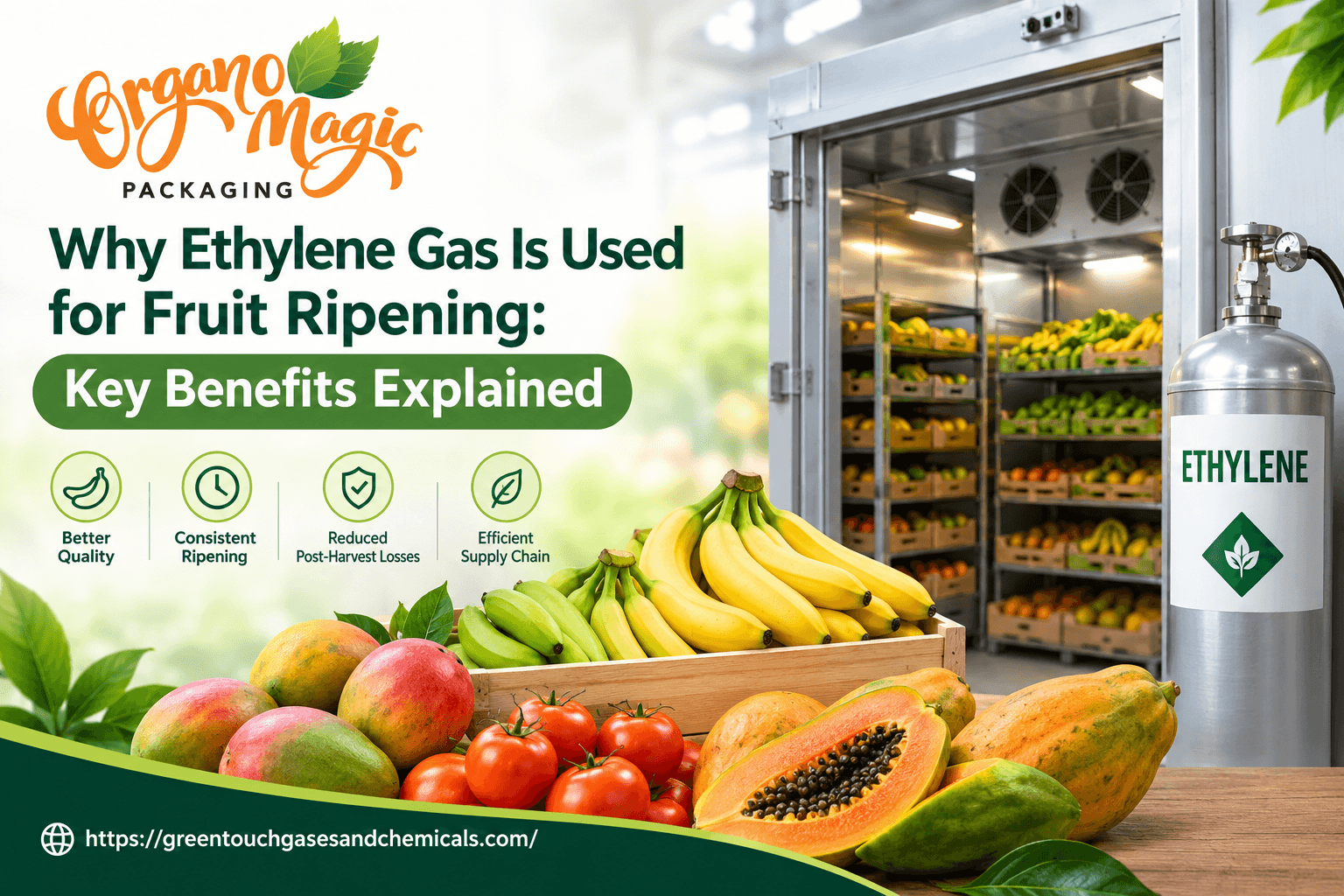
Why Ethylene Gas Is Used for Fruit Ripening: Key Benefits Explained
What Is Ethylene Gas and How Does It Work?
Ethylene is a naturally occurring gaseous plant hormone that regulates fruit development, ripening, and ageing. Many fruits produce ethylene as they mature, triggering biochemical changes that influence their appearance, texture, aroma, and taste.
During ripening, several important changes take place:
- Colour development: Green pigments break down, allowing characteristic yellow, orange, or red colours to appear.
- Texture changes: Enzymatic activity softens fruit tissues and improves eating quality.
- Flavour development: Changes in sugars, acids, and aromatic compounds contribute to the fruit’s characteristic taste and smell.
- Respiration changes: The fruit’s metabolic activity changes as it progresses through the ripening process.
Ethylene does not work equally on every fruit. Bananas, mangoes, papayas, and tomatoes are examples of climacteric fruits that respond to ethylene during ripening. Other fruits, such as grapes and strawberries, do not show the same ethylene-triggered ripening response.
The fruit must also be harvested at an appropriate maturity stage. Ethylene cannot compensate for produce that is too immature, damaged, or affected by disease.
Why Is Ethylene Gas Used for Commercial Fruit Ripening?
Commercial fruit businesses need predictable ripening schedules to meet customer demand and maintain consistent quality. Controlled ethylene exposure helps manage the natural ripening process for suitable fruits.
1. Promotes More Uniform Ripening
Fruits harvested from different plants or orchard sections may ripen at different rates. Controlled ethylene exposure can help bring suitable fruits closer to a consistent stage of ripeness.
For example, banana distributors can use dedicated ripening chambers to prepare batches for retail delivery. More consistent colour and firmness make grading, packaging, and stock management easier.
2. Improves Supply Chain Planning
Fruit ripening affects the timing of harvesting, transportation, storage, and sales. When ripening occurs unpredictably, businesses may struggle to coordinate deliveries and manage inventory.
Controlled treatment helps operators plan when batches are likely to become market-ready. This can be particularly useful for wholesalers and retailers that supply multiple stores or handle large volumes of perishable produce.
3. Supports Better Fruit Quality
Appropriate ethylene exposure can support the development of characteristic colour, texture, aroma, and flavour in mature fruits. These changes help produce reach the expected quality for consumption.
However, the final result depends on several factors, including fruit variety, maturity, temperature, humidity, and handling. Ethylene cannot correct physical damage, poor storage, or inadequate harvesting practices.
4. Helps Reduce Post-Harvest Losses
Uncontrolled ripening can result in overripe fruit, inconsistent batches, and avoidable waste. A well-managed ripening process helps businesses coordinate stock rotation and distribution more effectively.
Although ethylene can support better inventory management, reducing losses also requires appropriate packaging, storage, hygiene, transportation, and demand forecasting.
5. Helps Match Market Demand
Different customers prefer fruits at different stages of ripeness. Some retailers need firmer bananas that can remain on shelves longer, while others require fruit that is ready for immediate consumption.
Controlled ripening helps businesses prepare produce according to distribution schedules and customer requirements. The process must be planned carefully to preserve quality and maintain a suitable shelf life.
How Does Ethylene Gas Fruit Ripening Work in Commercial Facilities?
Natural ripening and controlled commercial ripening rely on the same biological processes. The main difference is that commercial facilities provide greater control over the environment and timing.
Ripening chambers may include temperature controls, humidity management, ventilation systems, gas distribution equipment, and monitoring devices. These features help operators maintain suitable conditions for the selected fruit.
A typical process involves inspecting incoming fruit, confirming its maturity, arranging it in a suitable chamber, applying the approved treatment, and monitoring changes during ripening. Once the desired maturity is reached, the fruit can be prepared for distribution.
The treatment conditions must match the fruit variety and maturity stage. Businesses should not apply the same concentration, exposure period, or temperature settings to every crop without appropriate technical guidance.
What Is the Role of Green Touch Ethylene Ripener?
The green touch ethylene ripener keyword is relevant to businesses researching ethylene-based fruit ripening solutions. Before choosing a particular product, buyers should understand its intended application, delivery method, technical specifications, and operating requirements.
Products and systems may differ in how ethylene is supplied or delivered. These differences can affect equipment compatibility, application procedures, monitoring needs, and safety precautions.
Fruit traders, distributors, and warehouse operators should review the manufacturer's documentation and confirm that the product is suitable for their fruit varieties and intended use. They should also verify applicable food safety requirements and ensure that staff understand the recommended operating procedures.
A suitable ripening solution should offer reliable performance while supporting consistent fruit quality, worker safety, and responsible post-harvest management. Businesses should evaluate the complete process rather than selecting a product based only on price or advertised capacity.
What Is Ethylene for Fruit Ripening Used For?
Ethylene For Fruit Ripening is commonly associated with post-harvest operations that require fruits to reach a suitable stage of maturity before distribution.
Different fruits respond to ethylene in different ways:
- Bananas: Controlled exposure helps develop the expected yellow colour and suitable firmness.
- Mangoes: Ethylene can support natural ripening and the development of characteristic colour, aroma, and texture.
- Papayas: Appropriate treatment can help improve ripening consistency when fruits have reached suitable maturity.
- Tomatoes: Ethylene can support colour development and help manage ripening before sale.
These applications require crop-specific procedures. Factors such as variety, maturity, temperature, and storage conditions influence how quickly a fruit responds.
Businesses should therefore use reliable technical guidance when establishing ripening protocols. Regular monitoring and proper recordkeeping can help identify inconsistencies and improve process control over time.
Is Ethylene Gas Safe for Fruit Ripening?
Ethylene can be used for controlled fruit ripening when appropriate methods, equipment, and safety procedures are followed. However, safe use depends on the source of the gas, its concentration, the application method, ventilation, and compliance with applicable regulations.
In India, the Food Safety and Standards Authority of India (FSSAI) provides guidance on artificial fruit ripening. Its guidance discusses ethylene use under specified conditions, including concentrations up to 100 parts per million (ppm), depending on the crop, variety, and maturity. This should not be interpreted as a universal operating setting; businesses must follow the applicable requirements and suitable crop-specific instructions.
FSSAI also prohibits calcium carbide for artificial fruit ripening under Regulation 2.3.5 of the Food Safety and Standards (Prohibition and Restrictions on Sales) Regulations, 2011. Calcium carbide can release acetylene and may contain harmful impurities. Businesses should also avoid practices that allow ripening-agent preparations to come into direct contact with fruit.
For responsible operations, facilities should maintain suitable ventilation, provide staff training, follow emergency procedures, monitor chamber conditions, and keep treatment records.
Best Practices for Effective Fruit Ripening
Consistent results depend on more than the ripening agent. Businesses should establish a documented process that considers fruit maturity, environmental conditions, equipment performance, and distribution requirements.
Important practices include:
- Select suitable fruit: Inspect incoming produce for maturity, physical damage, and signs of disease before treatment.
- Prepare the chamber: Check ventilation, temperature controls, humidity management, and gas distribution equipment.
- Follow approved instructions: Apply the appropriate treatment conditions for the fruit variety and maturity stage.
- Monitor ripening progress: Record temperature, humidity, treatment conditions, and changes in colour and firmness.
- Manage post-treatment handling: Use appropriate storage conditions, avoid rough handling, and distribute fruit according to its remaining shelf life.
For example, a wholesaler handling several banana shipments each week can maintain batch records to compare ripening results and identify differences between deliveries. These records can help improve scheduling, reduce unnecessary waste, and maintain consistent product quality.
Expert Considerations Before Choosing a Ripening Solution
Investing in commercial ripening equipment requires careful evaluation of operational needs, technical performance, and long-term costs.
Businesses should assess chamber capacity against average and peak seasonal demand. They should also consider energy consumption, maintenance, ventilation, monitoring equipment, staff training, and the availability of technical support.
Before purchasing a solution, review the supplier’s technical specifications, application instructions, safety documentation, and compliance information. Where possible, conduct controlled trials using representative fruit batches before implementing the process on a larger scale.
Avoid assuming that one treatment method will suit every fruit variety. Excessive exposure, inappropriate temperatures, poor airflow, and inadequate handling can all affect the final result. A reliable ripening system combines suitable technology with trained operators and effective quality control.
Key Takeaways
- Ethylene is a natural plant hormone that regulates the ripening of many fruits.
- Controlled ethylene exposure can improve ripening consistency and help businesses coordinate market supply.
- Bananas, mangoes, papayas, and tomatoes are examples of fruits that respond to ethylene.
- Fruit maturity, temperature, humidity, and handling practices influence the effectiveness of treatment.
- Suitable ripening chambers and trained operators help maintain quality and support safe operations.
- Businesses in India must follow applicable FSSAI requirements and avoid prohibited ripening agents such as calcium carbide.
- Proper harvesting, storage, transportation, and inventory management remain essential for reducing post-harvest losses.
Conclusion
Ethylene gas has become an important part of commercial fruit ripening because it helps businesses manage a natural process more consistently. Its benefits include improved ripening schedules, better coordination across the supply chain, and more predictable fruit quality when the correct conditions are maintained.
Understanding ethylene gas fruit ripening also means recognising the importance of food safety, appropriate equipment, crop-specific treatment conditions, and regulatory compliance. Businesses evaluating a fruit ripening chemical or ethylene delivery system should consider technical performance, operating costs, safety requirements, and long-term reliability before making a decision.
By following established post-harvest practices and consulting official food safety guidance, fruit businesses can make better-informed decisions and support the delivery of quality produce to consumers.